Like the previous blogs, we are using data from the Labour Force Survey for October-December between 2001 and 2014.
Changes in male trade union membership
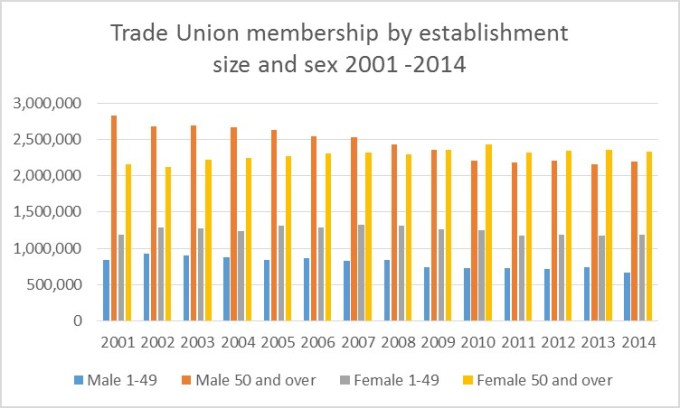
Males trade union membership in establishments between 1-49 employees membership deceased by 20.4 per cent between 2001 and 2014. Declining from approximately 842,000 to approximately 670,000. Between 2001 and 2014 trade union density declined by 28.6 per cent from 16.3 per cent to 11.6 per cent.
For male trade union membership in establishments with employees of 50 and over there was a similar decrease of 22.6 per cent from 2.8 million to 2.2 million between 2001 and 2014. Trade union density during this period declined by 23.3 per cent from 39.6 per cent to 30.4 per cent.
Changes in female trade union membership
Unlike male trade union membership by establishment size female trade union membership remained stable or increased.
Females trade union membership in establishments between 1-49 employees’ trade union membership increased by 0.7 per cent between 2001 and 2014. Increasing from approximately 1.1 million to approximately 1.2 million. However, between 2001 and 2014 trade union density declined by 9.7 per cent from 16.3 per cent to 11.6 per cent.
For female trade union membership in establishments with employees of 50 and over. Overall trade union membership increased by 8.2 per cent from 2.2 million to 2.3 million between 2001 and 2014. Trade union density during this period declined by -2.0 per cent from 36.8 per cent to 36.1 per cent.
Changes in Employment in Establishment Sizes
Male Employment in establishments between 1 and 49 employees increased by 11.4 per cent between 2001 and 2014. Increasing from just under 5.2 million to just under 5.8 million.
During the same period male employment in establishments of 50 and over employees remained stable increasing by 0.9 per cent.
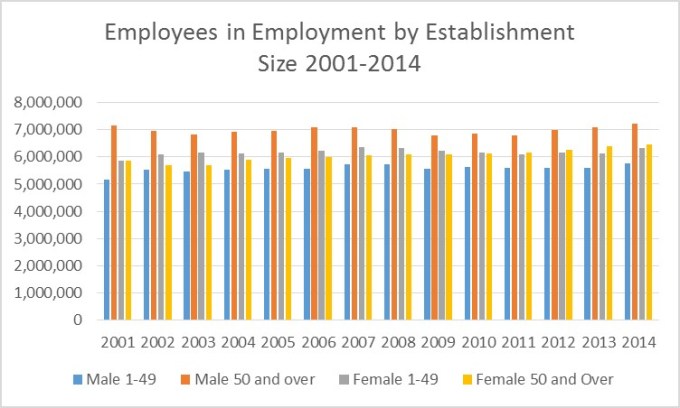
Female employment in establishments between 1 and 49 employees increased by 8.0 per cent between 2001 and 2014. Increasing from just under 5.9 million to just over 6.3 million.
During the same period female employment in establishments of 50 and over employees increased by 10.4 per cent from just over 5.8 million to under 6.5 million..
Summary
It has been argued that trade union membership has declined in part due to the increase of smaller firms. However, looking at this data set it is difficult to see that this is the case. It is however possible that because we are using aggregated data, we are missing some elements of this effect. To examine this in more detail would require dis-aggregating the data into smaller classes e.g. 1-10, 11-20, 21-30, 31 to 40, and 41 to 49. Also the time series may need to be extended backward to see if this effect was more pronounced before 2001. When we do a more detailed analysis for the research article this may be clearer.
However, the decline in trade union membership by establishment size does appear to be due to falling male trade union membership, in percentage terms, as we have seen in previous blogs.
 Trade Union Reseach Blog