In this blog we will examine what changes have taken place in trade union membership in the United Kingdom by full-time and part-time status, and by gender between 2001 and 2014. We will also examine the changes that have taken place in employment, again by full-time and part-time status, and by gender.
Changes in Male Union Membership
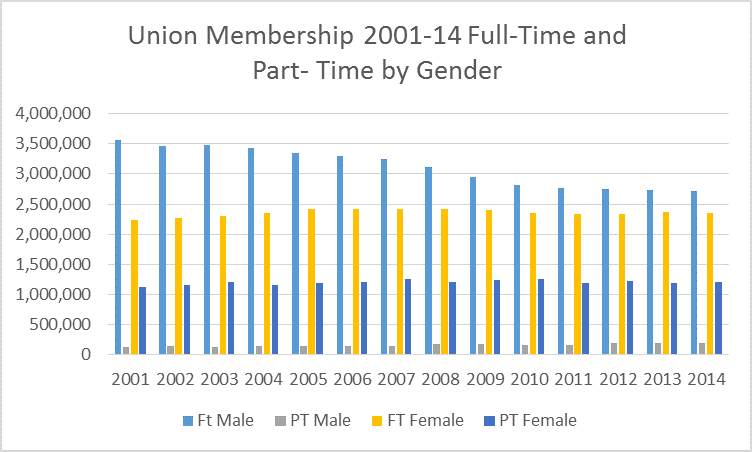
Between 2001 and 2014 male FT trade union membership declined by 853,596 from just under 3.6m to 2.7m. This was a decrease of 24.0 per cent, and over sixty per cent of the loss occurred between 2007 and 2014.
In regards to trade union density, this declined from 31.4 per cent to 23.3 per cent, a decrease of nearly 26 per cent.
Male PT trade union membership however increased by 56,534 from 134,090 in 2001 to 190,624. However, trade union density decreased by 2.7 per cent from 12.6 per cent to 12.3 per cent. This was due to the increase in the number of PT male employees – see below.
Changes in Female Union Membership
In contrast to male FT trade union membership female FT membership increased by 119,594 from 2.2m to just under 2.4m, an increase of 5.4 per cent. FT female union membership peaked in 2008 at just over 2.4m, but has declined moderately since then to 2,352,309.
Trade union density has declined by 7.4 per cent from 33.3 per cent to 30.9 per cent. And like male union density, this is due to the increased number of female employees.
Female PT union membership increased by 78,049 from just over 1.1m to just over 1.2m an increase of 7.0 per cent. Trade union density increased from 22.1 per cent to 22.7 per cent, an increase of 2.4 per cent, even though female PT employment increased over the period.
Changes in Employment
Male Employees
Between 2001 and 2014 male FT employees increased by 2.3 per cent from just under 11.4m to just over 11.6m. For PT male employees there was a considerable increase of 46.1 per cent from under 1.1m to just under 1.6m.

Female Employees
Between 2001 and 2014 female FT employees increased by 13.7 per cent from 6.7m to 7.6m an increase of 921,621. For female PT employees increased by 4.5 per cent from 5.0m to 5.3m.
Summary
Looking at the data it confirms the analysis of earlier blogs that the decline in trade union membership is due to the decline of male trade union membership. However, this analysis specifically identifies that it is male FT trade union membership as the major factor in this decline. The reasons for this are not yet clear.
In the next two blogs we will examine what has happened to trade union membership in the private and public sector, which may go in some way to answer this question.
 Trade Union Reseach Blog
One thought on “Trade Union Membership FT and PT by Gender”