In this blog we will look at the changes in trade union membership in the private sector in the United Kingdom (UK). We start with the overall changes in trade union membership. Then we examine the changes in trade union membership by employment status. We then look at the changes in male trade union membership. Finally we examine the changes in female trade union membership.
As with previous blogs the data source for this analysis is the Labour Force Survey Oct-Dec 2001-2014.
Overall Change in Trade Union Membership in the Private Sector
Between 2001 and 2014 total trade union membership in the private sector in the UK declined by just over 592,000, a decline of eighteen per cent – see Fig 1. Overall trade union density declined from 18.4 per cent to 14.0 per cent, a percentage change of 23.6 per cent over this period.
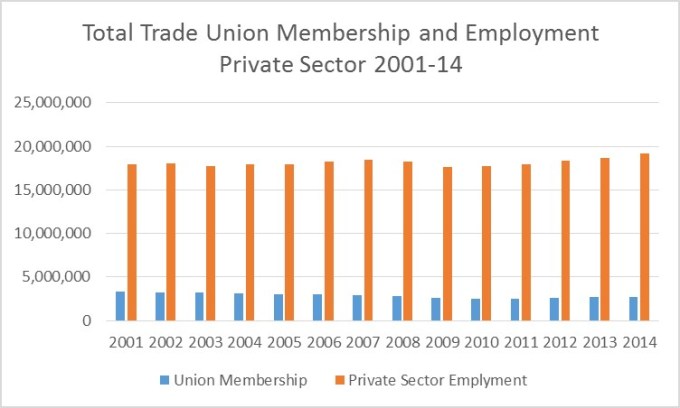
Fig 1
During the same period private sector employment increased by 1,303,269 an increase of 7.3 percent, from just over 17.9m to just under 19.2m.
Change in Trade Union Membership by Employment Status
Between 2001 and 2014 full-time (FT) trade union membership in the private sector of the UK declined by just over 630,000 from just under 2.9m to just under 2.2m, a decline of twenty-two per cent – see Fig 2.
Overall trade union density for FT trade union members declined from 20.8 per cent to 15.4 per cent, a percentage change of 25.7 per cent over the period.
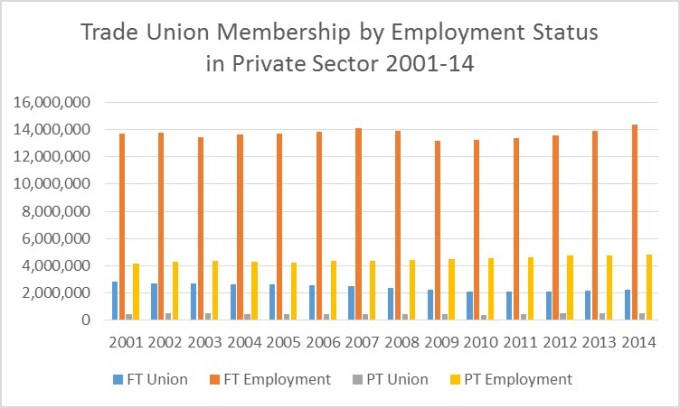
Fig 2
The change in part-time (PT) trade union membership between 2001 and 2014 was marginally positive. It increased by 8.6 per cent from just over 437,000 to just under 475,000. However, at the same time trade union density declined by 5.9 per cent from 10.5 per cent to 9.8 per cent.
Change in Male Trade Union Membership
Overall FT male union membership in all sectors (private and public) in the UK declined by 853,596 between 2001 and 2014 – see https://thedocsblogblog.wordpress.com/2016/02/23/trade-union-membership-ft-and-pt-by-gender/. During the same period FT male union membership in the private sector decreased by 595,306 – see Fig 3. Therefore we can say that approximately seventy percent of the decline in FT male union membership between 2001 and 2014 was a result of the decline in the private sector trade union membership.
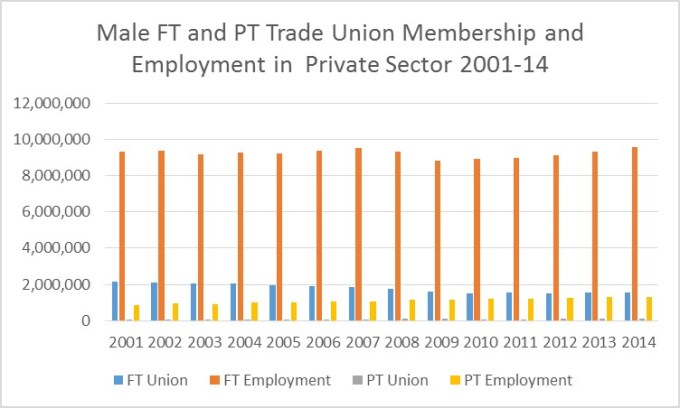
Fig 3
Between 2001 and 2014 FT employment in the private sector increased by 210,683 from just over 9.3m to just over 9.5m, an increase of 2.3 per cent.
PT trade union membership in the private sector between 2001 and 2014 increased by 32,500 from under 74,000 to just over 106,000, and increase of 44.2 per cent. During the same period PT employment increased by 32,564 from 879,168 to 1,280,568, and increase of 45.7 per cent.
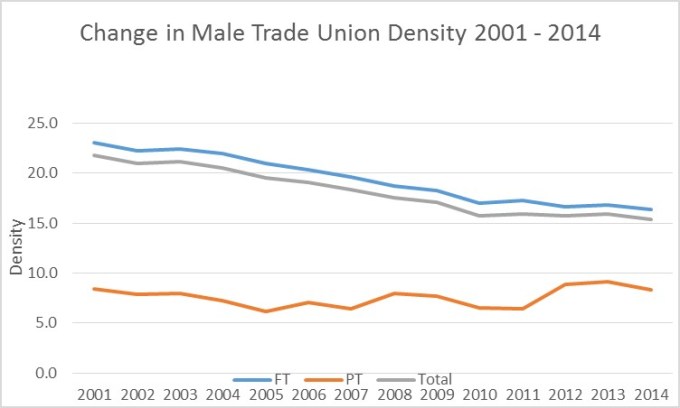
Fig 4
In regards to trade union density, FT density declined from 23.1 per cent to 16.3 per cent, a decline of 29.2 per cent – see Fig 4. For PT density it stayed relative stable at 8.3 per cent, although it reach a low of 6.1 per cent in 2005. Total union density decreased 29.5 per cent from 21.8 per cent to 15.4 per cent
Change in Female Trade Union Membership
Between 2001 and 2014 female FT trade union membership decreased by 5.0 per cent from 698,486 to 663,732 – see Fig 5. During this period PT trade union membership increased slightly by 1.4 per cent from 363,507 to 368,672 an increase of 5,165.
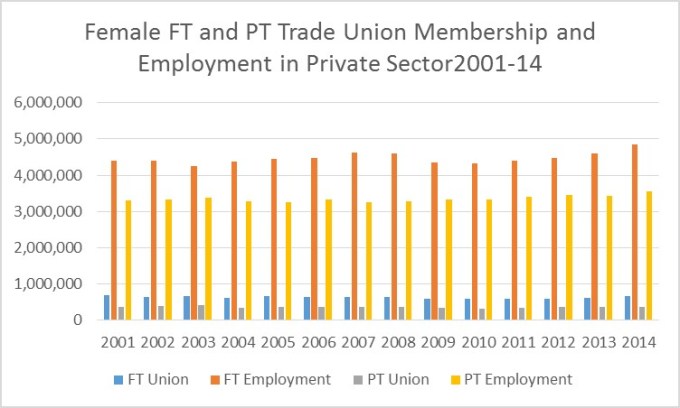
Fig 5
FT employment during this period increased by 10 per cent from 4.4m to 4.8m. PT employment increased slightly by 1.4 per cent from 3.3m to 3.5m.
FT trade union density declined by 13.8 per cent from 15.9 per cent to 13.7 per cent – see Fig 6
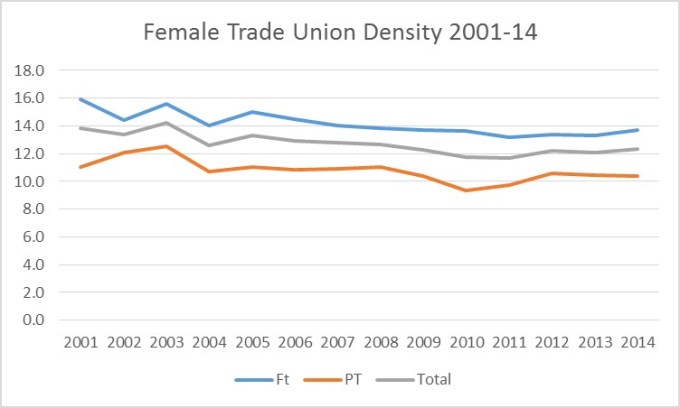
Fig 6
PT trade union density declined by 5.5 per cent from 11.0 per cent to 10.4 per cent. Total PT trade union density declined by 10.8 per cent from 13.8 per cent to 12.3 per cent.
Summary
As with previous blogs, this blog has identified that the major decline in the trade union membership in the UK is a result of the decline of FT male trade union membership. The most striking figure to come out of the current research into changes in trade union membership is that approximately seventy per cent of the decline in overall FT male union membership between 2001 and 2014 was a result of the decline in FT private sector trade union membership.
The question for a future blog will be, were there any particular sectors where this decline was significant? Or was it a general decline across all sectors?
In the next blog we will examine the changes that have taken place in the public sector trade union membership.
 Trade Union Reseach Blog