In this blog we will look at the changes in trade union membership in the public sector in the United Kingdom (UK). We start by examining the overall changes in trade union membership. Then we look at the changes in trade union membership by employment status. We then examine the changes in male trade union membership by employment status. Finally, we examine the changes in female trade union membership, again by employment status.
As with previous blogs the data source for this analysis is the Labour Force Survey Oct-Dec 2001-2014.
Overall Change in Trade Union Membership in the Public Sector
Between 2001 and 2014 total trade union membership in the public sector in the UK declined by 27,420 a decline of nine per cent – see Fig 1. Overall trade union density declined from 59.5 per cent to 54.1 per cent, a percentage change of nine per cent over this period.

Fig 1
During the same period public sector employment increased by just under 565,000, an increase of 9.1 percent, from just over 6.2m to just over 6.8m.
Change in Trade Union Membership by Employment Status
Between 2001 and 2014 full-time (FT) trade union membership in the public sector of the UK declined by just over 121,500 from just 2.9m to just under 2.8m, a decline of 4.2 per cent – see Fig 2.
Overall trade union density for FT trade union members declined from 67.5 per cent to 57.8 per cent, a percentage change of 14.3 per cent over the period.
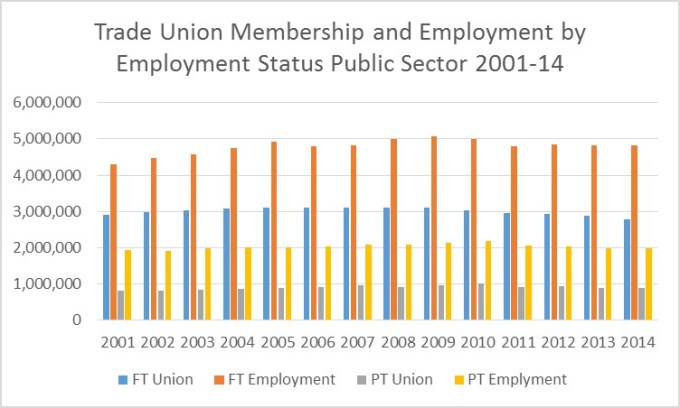
Fig 2
The change in part-time (PT) trade union membership between 2001 and 2014 was positive. It increased by per 11.7 cent from just under 805,000 to just under 899,000. At the same time trade union density increased by 8.4 per cent from 41.7 per cent to 45.2 per cent.
Change in Male Total Trade Union Membership by Employment Status
Between 2001 and 2014 male trade union membership in the public sector declined by 230,598, from 1.4m to 1.2m, a decrease of sixteen per cent – see Fig 3. And trade union density decreased by 14.3 per cent from 67.5 per cent to 57.8 per cent.
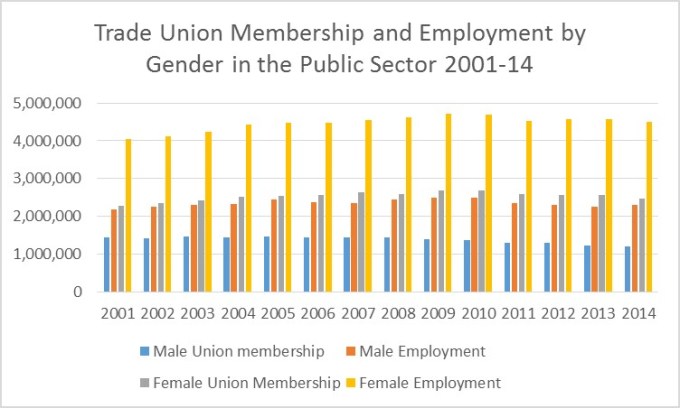
Fig 3
Over the same period male public sector employment increased by 122,404 from 2.2m to 2.3m an increase 5.6 per cent.
Change in Female Total Trade Union Membership by Employment Status
Between 2001 and 2014 female trade union membership in the public sector increased by 203,178 from 2.3m to 2.5m, an increase of nine per cent – see Fig 3. However, trade union density declined slightly from fifty-six per cent to fifty-five per cent a decrease of 1.8 per cent. These apparent contradictory figures can be explained by the increase in total female employment which increased by 442,589 from 4m to 4.5m, an increase of nearly eleven per cent.
Change in Male Trade Union Membership by Employment Status
Between 2001 and 2014 FT male union membership in the public sector decreased by 254,738 – see Fig 4. From just under 1.4m to 1.1m, a decline of 18.4 per cent. This deterioration was not as great as that for the private sector of 27.6 per cent for the same period. However, it would appear to reinforce the evidence from previous blogs – see: https://thedocsblogblog.wordpress.com/ – that one of the major factor in the decline of trade union membership in the UK is due to the decrease of male FT trade union membership.
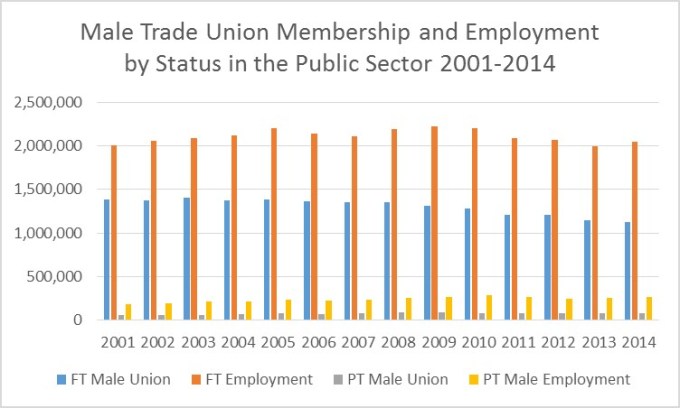
Fig 4
During the same period FT male employment in the public sector increased by 40,864 from just over 2m, an increase of 2.0 per cent.
In regards to PT male trade union membership in the public sector between 2001 and 2014 it increased by 24,140 from 56,000 to 80,226, and increase of 43 per cent. During the same period PT employment increased by 81,540 from 179,070 to 260,610, and increase of 45.5 per cent.
Trade union density declined during this period by 1.7 per cent from 31.3 to 30.8 per cent.
Change in Female Trade Union Membership by Employment Status
During the same period FT female union membership in the public sector increased by 133,152 – see Fig 5. From over 1.5m to 1.65m, an increase of 8.8 per cent.
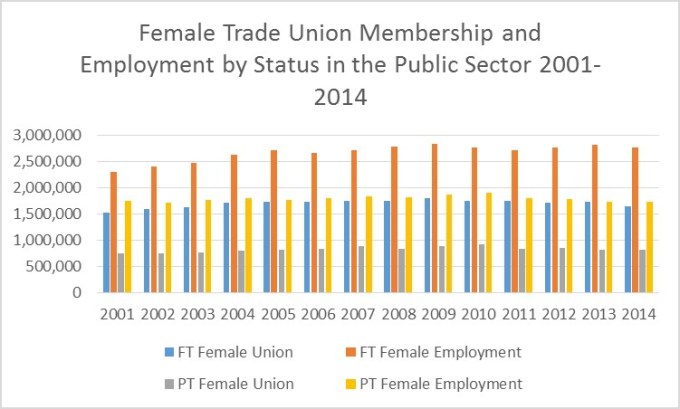
Fig 5
At the same time, FT female employment increased by 466,043 from 2.3m to 2.7m an increase of twenty per cent.
In contrast, trade union density declined over this period from 66.1 per cent to 59.8 per cent, a decrease of 6.3 per cent.
In regards to PT female union membership, this increased by 9.4 per cent from 748,714 to 818,741. During the same period employment declined from 1,751,336 to
1,727,882, a decrease of 1.3 per cent. And trade union density increased from 42.8 to 47.4 per cent, an increase of 10.8 per cent.
Summary
Trade union density in the public sector density is considerably larger than in the private sector – see Fig 6. Although in regards to employment it is only a third of the size of the private sector. However, between 2001 and 2014 it has declined over all by nine per cent. While the private sector decreased by 23.6 overall.

Fig 6
However, like the male FT private sector trade union membership it has had the largest decrease in membership of the four employment status groups in the public sector, a decline of 18.4 per cent – see Fig 7.
The decline of 254,738 members accounts for thirty-two per cent of the total decline in total trade union membership in the UK between 2001 and 2014.
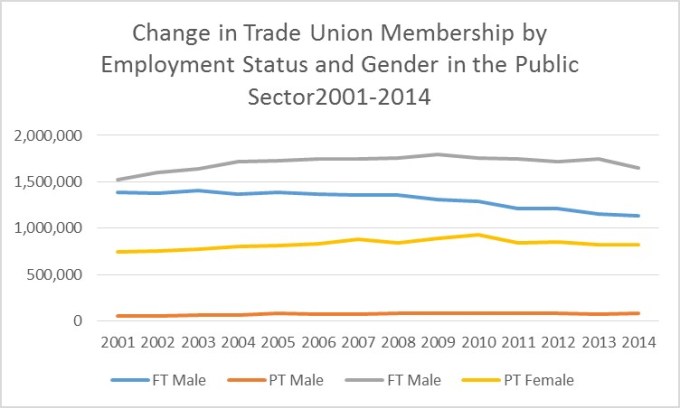
Fig 7
In the forthcoming blogs we will examine what has happened to trade union membership by individual industries to see if this can help explain this decline.
 Trade Union Reseach Blog