We have estimated the changes in trade union membership using data from the 2016 and 2017 October – December Labour Force Survey produced by the Office of National Statistics (ONS).
1 Trade Union Membership
There has been a very small increase in male trade union membership of 0.9 per cent, and a slight decline in female trade union membership of 0.4 per cent – see Fig 1. Overall there has been an increase of 10,000 members, an increase of .0.2 per cent.
Over all employee trade union membership remains relatively stable in actual numbers.
 Fig 1: Female and Male Trade Union Membership 2016-17Source ONS
2 Trade Union Density
However, trade union density for both female and male density has decreased. Between 2016 and 2017 male trade union density declined by 0.1 from 20.9 per cent to 20.8 per cent, a decrease of 0.7per cent – see Figure 2. Even though male trade union membership increased between 2016 and 2017 the reason why the trade union density did not increase was that male employment increased at a greater rate – see Figure 4 – than the trade union membership.
Female trade union density declined was greater than the male density, it declined by 0.4 from 25.6 per cent to 25.2 per cent, a percentage decrease of 1.5 per cent.
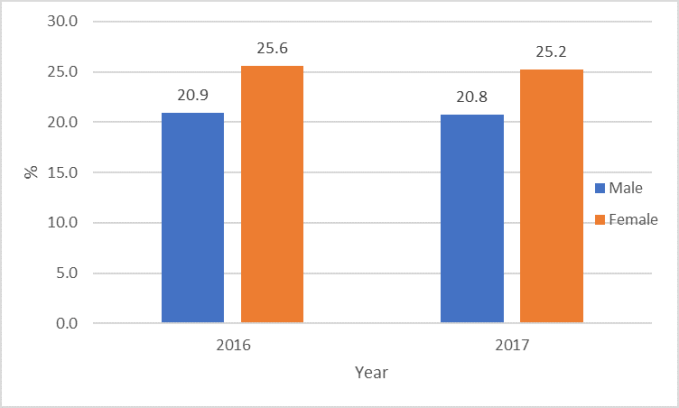 Fig 2: Female and Male Trade Union Density 2016-17 Source ONS
3 Trade Union Composition
The composition of male trade union employees between 2016 and 2017 increased by 0.3 from 45.4 to 45.7 per cent, an increase of 0.7 per cent – see Figure 3. It is axiomatic that the female composition decreased by 0.3 from 54.6 to 54.3 per cent.
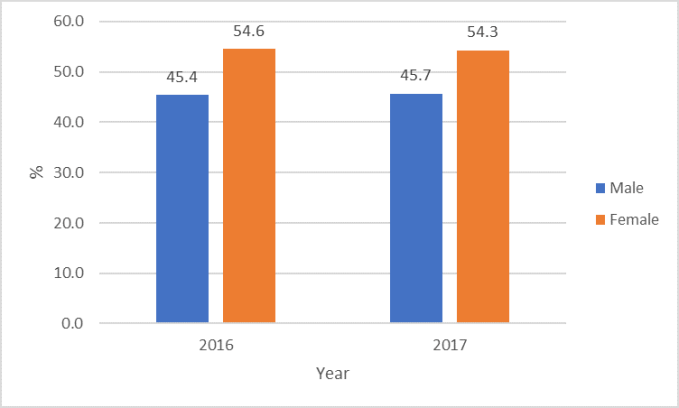 Fig 3: Female and Male Trade Union Composition 2016-17 Source ONS.
4 Employment
Between 2016 and 2017 male employees increased by 210,000 from 13.5m to 13.7m an increase of 1.6 per cent. For female employees they had an increase of 148,000 from 13.3m to 13.4m a increase of 1.1 percent – see Figure 4.
 Fig 4: Female and Male Employment 2016-17 Source ONS
5 Employee Composition
In between 2016 and 2017 the male composition increased by 0.1 from 50.4 to 50.5 percent an increase of 0.2 percent – see Figure 5. Like trade union composition it is axiomatic that the female composition decreased by 0.1 for 2016-17.
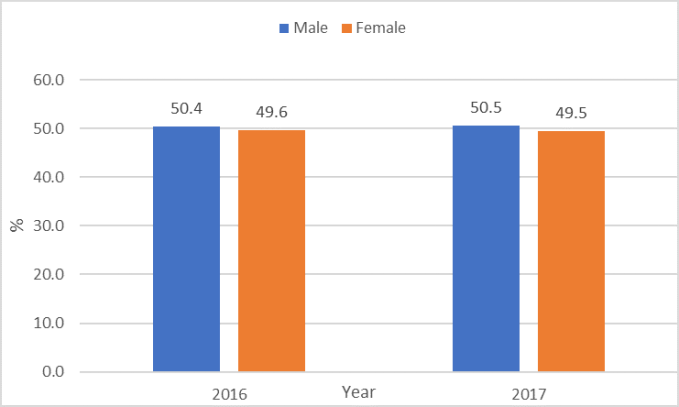 Fig 5: Female and Male Employment Composition 2016-17 Source ONS
Technical Note
The Department for Business, Energy & Industrial Strategy (BEIS) will publish its Trade union membership 2017: statistical bulletin at the end of April or the beginning of May. The BEIS figures may differ slight from the figures used in this blog. There are three reasons for this. The first is rounding errors, and the second is that we are using a more aggregated data set than that used by BEIS. Third is the weight used by BEIS used in its calculations. Unfortunately, BEIS does not report the weighting used in its bulletin so it is possible that we are using a different weighting to BEIS. However, the differences should be well within normal statistical errors.
 Trade Union Reseach Blog