First Estimates of Trade Union Membership 2020.
According to the Gov.UK website, the Department for Business, Energy and Industrial Strategy (BEIS) – see https://www.gov.uk/government/statistics/announcements/trade-union-statistics-2020 – is due to publish the trade union statistics and bulletin for 2020 on the 27th of May.
This blog examines the changes in trade union(TU) membership by gender between 2019 and 2020 using data from the October-December Labour Force Survey (LFS) and changes in the overall TU membership between 2001 and 2020.
Between 2019 and 2020, total TU membership increased by 107,970 – see Table 1 – an increase of 1.7 per cent. Both male and female TU membership increased by 1.7 per cent. The actual increases were 46,142 for males and 61,828 for females.
| Year | Male | Female | Total |
| 2019 | 2,752,794 | 3,693,467 | 6,446,261 |
| 2020 | 2,798,936 | 3,755,295 | 6,554,231 |
| 2019-20 | |||
| Actual change | 46,142 | 61,828 | 107,970 |
| % Change | 1.7 | 1.7 | 1.7 |
Table 1: Trade Union Membership Employees 2019-20
Overall there was an increase of 1.1 per cent in TU density between 2019-20. Male TU density increased by 1.5 per cent, and female TU density increased by 0.8 per cent.
| Year | Male | Female | Total |
| 2019 | 19.9 | 26.8 | 23.3 |
| 2020 | 20.1 | 27.0 | 23.6 |
| 2019-20 | |||
| Actual change | 0.3 | 0.2 | 0.3 |
| % Change | 1.5 | 0.8 | 1.1 |
Table 2: Trade Union Density 2019-20
Source: LFS Oct-Dec 2019-20
Change in TU Membership by Employees Between 2001-20
Between 2001 and 2020, TU membership has declined by 489,501; however, there are significant differences between genders. Male TU membership declined by 891,653, and as we shall see in a later blog, this was due in the main to the loss of manufacturing employment. Female TU membership increased by 402,152. However, this increase was not sufficient to counter the loss of male jobs – see Table 3 – resulting in the 489,501 net loss of TU membership.
| Year | Male | Female | Total |
| 2001 | 3,690,589 | 3,353,143 | 7,043,732 |
| 2020 | 2,798,936 | 3,755,295 | 6,554,231 |
| 2001-20 | |||
| Actual change | -891,653 | 402,152 | -489,501 |
| % Change | -24.2 | 12.0 | -6.9 |
| Source: Labour Force Survey October-December 2001 and 2020 |
Table 3: Trade Union Membership Employees 2019-20
Source: LFS Oct-Dec 2001 and 2020
Trade union density declined for both male and female membership – see Table 4. Although TU membership increased between 20001 and 2020, it did not increase at the same rate as female employment, which increased by 3,447,788 or 14.2 per cent.
| Year | Male | Female[i] | Total |
| 2001 | 29.7 | 28.5 | 23.3 |
| 2020 | 20.1 | 27.0 | 23.6 |
| 2001-20 | |||
| Actual change | -9.8 | -1.7 | -5.8 |
| % Change | -33.1 | -11.5 | -21.1 |
Table 4: Trade Union Membership Employees 2019-20
Source: LFS Oct-Dec 2001 and 2020
In Fig1 we show the TU membership for all employees between 2001 and 2020.
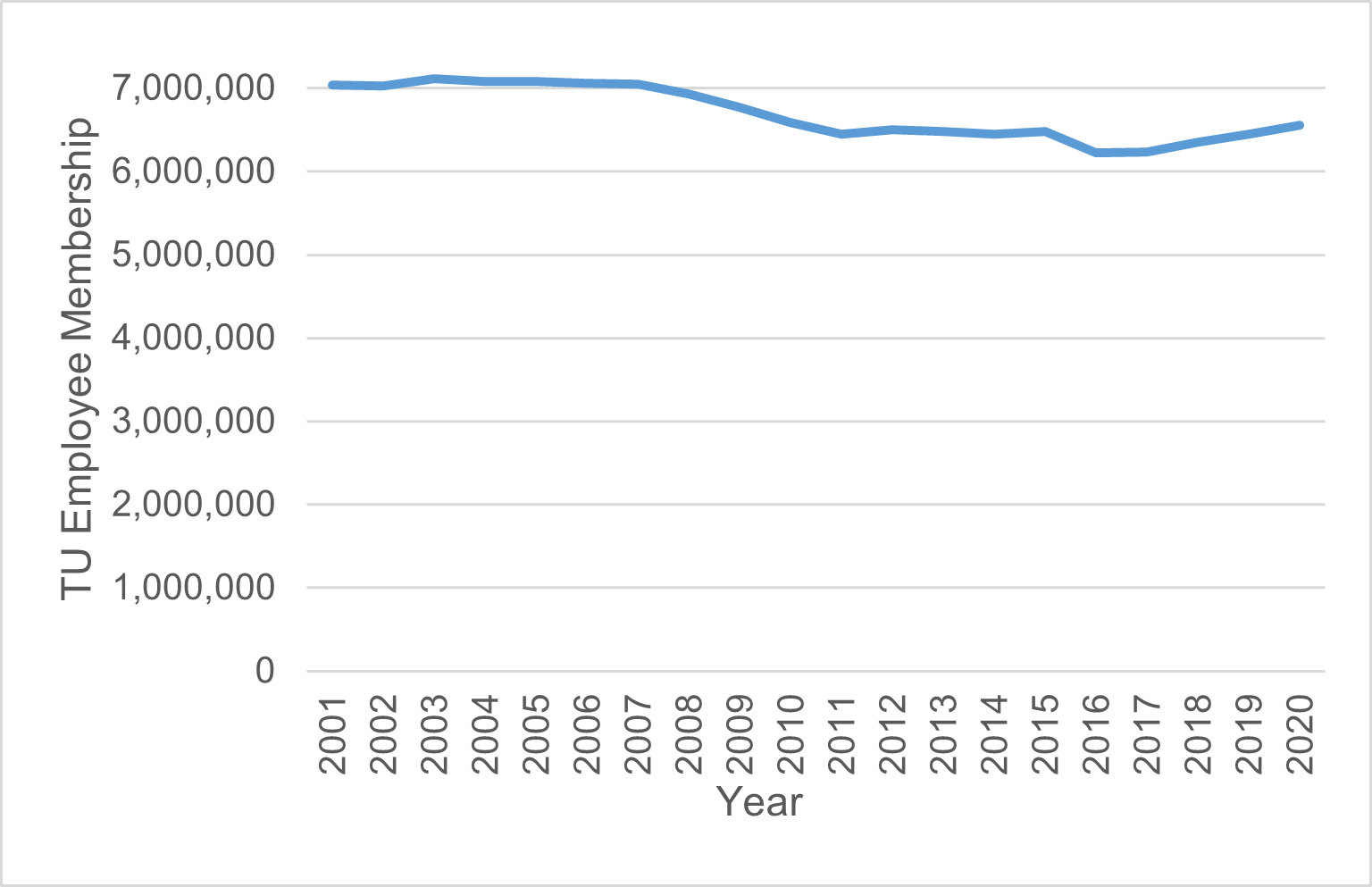
Source: Labour Force Surveys Oct-Dec 2001 to 2020.
Techincal Note
The figures published in this blog may not precisely match those published by BEIS due to rounding errors. In the past, there has been a difference of about 3,000 in each gender group between our figures and those published by BEIS.
The Office of National Statistics is reweighting the LFS from June this year, and as soon as the reweighted data is available, we will issue blogs with the revised figures.
Acknowledgement
We would like to thank Ivan Bishop, Statistician, Labour Market Directorate, Department for Business, Energy & Industrial Strategy, for his advice relating to calculating the statistics used for this blog.
[i] Figuers may not tally due to rounding errors
 Trade Union Reseach Blog